
Workers Safety Programs Reduce Claims for Texas Business
Workers safety programs reduce claims Texas business owners face, leading to lower premiums and a stronger bottom line through proactive risk management.

By Jeffrey Connors
For Texas business owners, the connection between a safe workplace and a healthier bottom line is undeniable. Every workplace injury not only affects the employee but also triggers a chain of financial consequences: higher insurance premiums, potential legal fees, lost productivity, and the administrative burden of managing claims. While many owners see workers compensation as a mandatory cost, the most successful ones view it as a starting point, not a strategy. The real opportunity lies in proactive safety management. Implementing robust workers safety programs reduce claims Texas business owners face every year, transforming what could be a financial drain into a competitive advantage. This article explores why investing in safety is one of the smartest financial decisions a Texas business can make, and how it directly impacts your insurance costs and operational stability.
Texas operates differently from most states when it comes to workers compensation. It is the only state where private employers are not legally required to carry workers compensation insurance. However, choosing to opt out is a massive risk. Without coverage, a single serious injury can result in a lawsuit that threatens the very existence of your company. For those who do carry coverage, which is the prudent choice for any business with employees, the cost is directly tied to your claims history. This is where safety programs shine. They are not just about compliance or checking a box; they are a direct lever you can pull to control your insurance expenses and protect your team.
The Direct Financial Impact of Safety Programs on Workers Comp Premiums
Your workers compensation premium is not a fixed cost. It is calculated based on your industry classification, your payroll, and most critically, your experience modification rate (MOD). The MOD is a numerical representation of your company's claims history compared to the average for your industry. A MOD of 1.0 means your claims are average. A MOD of 1.2 means you are 20% more expensive to insure than average, and you will pay 20% more on your base premium. A MOD of 0.8 means you have fewer or less severe claims, and you enjoy a 20% discount.
Workers safety programs reduce claims Texas business owners need to understand that this is not just about preventing an injury. It is about preventing the claim that follows. A comprehensive safety program directly reduces both the frequency and the severity of workplace injuries. Lower frequency means fewer claims, which directly lowers your MOD. Lower severity means that when an injury does occur, the medical costs and lost time are minimized, which also has a positive impact on your MOD. For example, a contractor with a MOD of 0.85 on a $500,000 premium saves $75,000 annually. That is real money that can be reinvested in the business, equipment, or even expanded safety training.
Beyond the MOD, a strong safety record makes your business more attractive to insurance carriers. In the competitive Texas market, carriers are eager to underwrite businesses with proven safety cultures. They see you as a lower risk, which gives them the confidence to offer more favorable rates and coverage options. Conversely, a business with a poor safety record will face higher premiums, fewer carrier options, and in some cases, difficulty finding coverage at all.
Core Components of an Effective Workers Safety Program
Building a safety program that actually reduces claims requires more than a poster on the breakroom wall. It demands a structured, ongoing commitment from leadership and every employee. While the specific hazards vary by industry, the foundational elements of a successful program are universal. Here are the five pillars that form the backbone of any effective safety initiative in Texas:
- Leadership Commitment: Safety must be a top-down priority. Owners and managers must demonstrate their commitment through actions, not just words. This includes allocating budget for safety equipment, participating in training, and holding everyone accountable, including themselves.
- Employee Training and Engagement: Regular, documented training is essential. It is not enough to have a one-time orientation. Ongoing training on specific hazards, safe work practices, and emergency procedures keeps safety top of mind. Engaging employees in safety committees empowers them to identify and report hazards without fear of retaliation.
- Hazard Identification and Control: This is the core of proactive risk management. Conduct regular job site or facility inspections to identify potential hazards. Implement controls, which can be engineering controls (like machine guards), administrative controls (like job rotation), or personal protective equipment (PPE). The key is to eliminate or minimize the hazard before it causes harm.
- Incident Investigation and Reporting: Even with the best programs, incidents will happen. The goal is not to assign blame, but to understand the root cause and prevent recurrence. A clear, non-punitive reporting system encourages employees to report near misses, which are invaluable warning signs. A thorough investigation of both incidents and near misses is a powerful learning tool.
- Continuous Improvement: A safety program is not static. It must be reviewed and updated regularly based on new equipment, new processes, or lessons learned from incidents. Regularly analyze your safety data, seek feedback from employees, and benchmark against industry best practices. This cycle of evaluation and adjustment is what drives long-term success.
When these components are implemented correctly, they create a culture of safety that permeates every level of the organization. This culture not only protects your workers but also improves morale and productivity. Employees who feel safe and valued are more likely to be engaged and efficient. This reduces turnover and the associated costs of hiring and training new staff, further strengthening your financial position.
How Safety Programs Reduce Claims in Specific Texas Industries
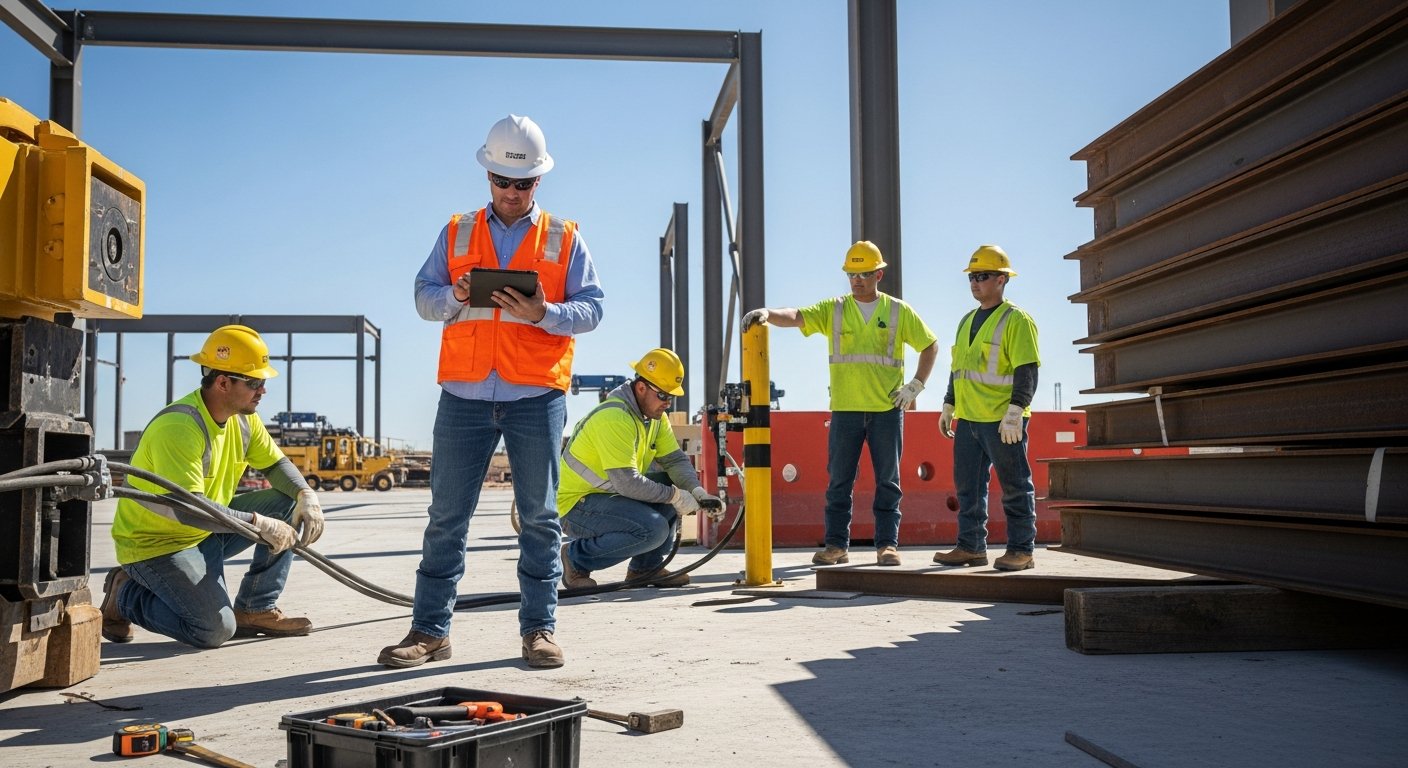
The principle that workers safety programs reduce claims Texas business holds true across all sectors, but the application looks different depending on your industry. A one-size-fits-all approach will not work. For Texas construction companies, the focus is often on fall protection, heavy machinery operation, and struck-by hazards. A robust program might include daily toolbox talks on specific tasks, rigorous equipment inspection routines, and a strict policy on wearing personal fall arrest systems when working at heights. These measures directly target the most common causes of severe and fatal injuries on construction sites.
For shop owners, such as auto repair or manufacturing facilities, the risks are different. They include repetitive motion injuries, exposure to chemicals and fumes, and accidents involving presses or other machinery. A safety program here might emphasize proper lifting techniques, the use of appropriate PPE like gloves and safety glasses, and regular maintenance of equipment to ensure it is in safe working order. For professional services firms, the primary risks are often ergonomic injuries (like carpal tunnel syndrome) and slips, trips, and falls in the office. A program could include ergonomic assessments for workstations, clear policies for keeping walkways clear, and training on how to properly lift heavy boxes of files or equipment.
By tailoring the safety program to the specific hazards of your industry, you make it more relevant and effective. This relevance increases employee buy-in, because they can see how the training and procedures directly protect them in their daily work. This is far more effective than a generic program that feels disconnected from the realities of the job.
Practical Steps to Implement a Safety Program in Your Texas Business
Implementing a comprehensive safety program may seem like a daunting task, especially for small or medium-sized businesses with limited resources. However, it does not have to be an overnight overhaul. Start with a few focused steps and build momentum from there. The following sequence provides a practical roadmap to get you started:
- Conduct a Baseline Audit: Start by assessing your current state. Walk through your facility or job sites and identify obvious hazards. Review your past incident reports and workers compensation claims data. This will give you a clear picture of where your highest risks are. You can also use free resources from the Texas Department of Insurance or OSHA to help identify common hazards in your industry.
- Develop a Written Safety Policy: A written policy is the foundation of your program. It should clearly state your commitment to safety and outline the responsibilities of both management and employees. It does not need to be lengthy, but it must be specific to your operations and accessible to everyone. This policy also becomes a critical document if you ever face a claim or an audit.
- Provide Regular Training: Start with a general orientation for all employees covering your safety policy, emergency procedures, and how to report a hazard or injury. Then, provide task-specific training for higher-risk jobs. Keep records of all training sessions, including who attended and what was covered. This documentation is essential for demonstrating your due diligence.
- Establish a Reporting and Investigation Process: Create a simple, non-punitive process for employees to report hazards and near misses. Make it clear that reporting a problem is a positive action. When an incident does occur, conduct a thorough investigation to find the root cause. Write down your findings and implement corrective actions.
- Review and Improve Regularly: Schedule a formal review of your safety program at least annually. Look at your claims data, training records, and investigation findings. Ask your employees for feedback. This is the time to make adjustments and set new goals for the coming year.
Following these steps will not instantly eliminate all risks, but it will create a system that consistently identifies and mitigates them. Over time, this systematic approach will lead to a measurable reduction in claims. You will see a positive trend in your MOD, which will translate to lower premiums. Furthermore, the very act of implementing a structured program demonstrates to your insurance carrier that you are a responsible and reliable risk. This can be a significant advantage when negotiating your policy.
An independent insurance agency like Texas Policies can be an invaluable partner in this process. While we do not write the safety policies, we understand what carriers look for. We can help you understand how your safety initiatives are likely to impact your premiums and provide guidance on the types of programs that are most valued in your industry. We also help you shop your coverage to carriers that offer the best rates for companies with strong safety records. This is a crucial advantage, because not all carriers weigh safety programs equally.
The Broader Benefits: Beyond Insurance Premiums
While the primary focus of this article is on reducing insurance claims, the benefits of a strong safety program extend far beyond your workers compensation premium. A safe workplace positively impacts nearly every aspect of your business. First, it protects your most valuable asset: your employees. Reducing injuries means your team is healthy, present, and able to perform their jobs. This reduces costly downtime and the disruption of finding and training replacement workers.
Second, a strong safety record enhances your company's reputation. It signals to potential employees that you are a responsible employer who values their well-being, making it easier to attract and retain top talent. It also matters to your clients. In industries like construction, a solid safety record is often a prerequisite for bidding on contracts. Many general contractors and project owners require subcontractors to maintain a certain EMR (Experience Modification Rate) to be eligible to work. A good safety program helps you qualify for more projects and win more business.
Third, safety programs reduce the indirect costs associated with injuries, which are often hidden and can be several times larger than the direct medical costs. These indirect costs include lost productivity, administrative time spent on claim management, potential fines from regulatory agencies, and the negative impact on employee morale after a serious incident. By preventing the injury in the first place, you avoid all of these costs entirely.
For Texas businesses, the choice is clear. Reactive management, where you simply respond to claims after they happen, is a losing strategy. It is costly, stressful, and puts your business at risk. Proactive safety management, where you actively work to prevent injuries, is a winning strategy. It is an investment that pays dividends in lower insurance costs, a more productive workforce, and a stronger, more resilient business. If you are ready to take control of your risk and build a safer future for your company and your employees, the first step is to evaluate your current program and make a commitment to improvement. To see how your safety efforts can translate into real premium savings, consider requesting a quote or speaking with a licensed advisor. A conversation about your operations and safety practices can reveal opportunities you may not have considered.